

Buying backlinks can sometimes look like it does something. Our position is clear all the same: we don't do it. A paid link may well do something, but for sustainable growth it is a weak strategy.
Anyone looking at online search behaviour around this topic mostly finds sales talk. That is exactly why a level-headed answer is needed. If you want to understand what backlinks are, that is the basis. The real question here is only this: is buying backlinks sensible? Usually not.
The short answer: does buying backlinks work?
Yes, sometimes it looks like it works. But that isn't the same as building a healthy foundation.
A bought link can create short-term movement, but it does not buy you stable authority. What you mainly buy is a nudge in a system that has become steadily better at recognising manipulation.
Compare it to an energy drink instead of sleep. You can feel sharper for a while, but it doesn't solve the underlying problem. It works the same way here. A single paid link can seem to speed something up while your content, structure and expertise are not yet strong enough.
Worth saying honestly: not everything is achievable with one tactic. If your content is thin, your internal structure is weak and nobody really mentions your brand or your experts, you are not going to fix that by buying links.
Why people buy backlinks anyway
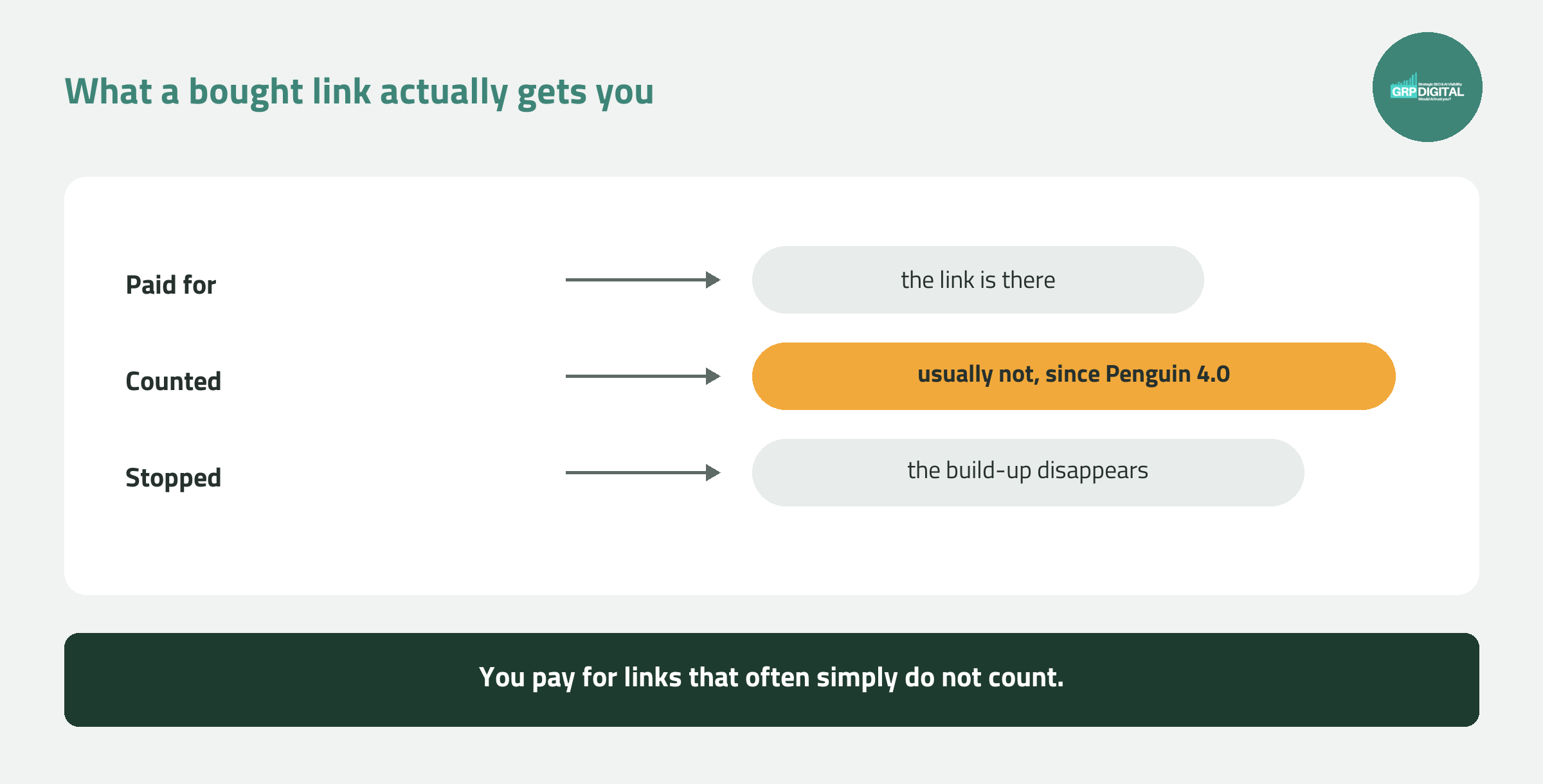
In practice it usually starts with an email or a conversation: an agency promises to get you to position 1 for a given keyword within two months. That sounds concrete, and it is cheaper than a year of building authority. We have seen it work too, in those first months. What does not get mentioned is that you are tied to it afterwards: stop the arrangement and the links disappear, and you sink back to where you started.
It isn’t hard to understand why companies choose this. In short: it looks faster, simpler and more controllable than building authority step by step.
Common reasons include:
- time pressure
- a competitive market
- a need for quick visible movement
- outsourcing difficult work
- the impression that competitors are doing it too
There is a psychological element in there as well. A backlink package feels concrete. You pay something, you get something. Whereas earned media, trade publications and building expertise seem less tangible at the start.
That makes the choice understandable, but not yet logical. Certainly not when you look at how search engines assess links and how unstable paid patterns can be.
Why we don't do it
We would rather build a system that stays standing when you stop pushing.
Bought links make you dependent on a stream you have to keep feeding. On top of that, once the pattern becomes too obvious, you send out a manipulation signal. And perhaps more importantly: you do not build a real reputation with it. A paid link is not the same as an earned mention.
On top of that, you can’t claim you want sustainable growth while relying on an approach that mainly works as long as you keep buying. Those two don’t go together.
The parasite argument
This is the main reason for us.
I don't do link building. I call it parasites: the links have to keep coming, and once it stops, you fall back.
Giacomo Perticara, founder and SEO strategist at GRP Digital
That is our estimate from experience, with no research behind it. But it is a pattern we often see in the market. If your growth hangs mainly on paid links, stopping becomes difficult. Your model then depends on a constant supply of bought links.
So build something that gets stronger as you add more good content, better context and more genuine mentions.
Short-term win, weak foundation
A rise in visibility is not automatic proof that your approach is sound. That is exactly why we look at this soberly.
Sometimes a link is sold with metrics or attractive scores. But that does not say enough about real value. Certainly not if you forget why Domain Authority is not a Google signal.
Our estimate based on our experience, not a research finding: bought links can sometimes look like they do something in the short term. It is just often hard to attribute cleanly. And even where there is an effect, the question remains whether you are building something that stays controllable and reliable over a longer period.
What Google says about this
Google is clear about this, but there is a nuance that often gets left out.
According to Google, link spam is “the practice of creating links to or from a site primarily for the purpose of manipulating search rankings”. Explicitly named as a violation: “Buying or selling links for ranking purposes”, including money for links, goods or services for links, and sending a product in exchange for an article with a link.
In its spam policy Google also says that sites violating this policy may rank lower or not appear at all, and that a manual action is possible.
The important nuance: Google also says that buying and selling links can be a normal part of the web economy for advertising and sponsorship purposes, as long as those links are properly marked with rel=”nofollow” or rel=”sponsored”. So the prohibition is not about every paid link, but about paid links for ranking purposes.
That distinction matters. Without that nuance the topic becomes needlessly black and white.
Penguin as a turning point
Penguin was an important moment in how Google deals with unnatural link patterns. The update rolled out on 24 April 2012, the name was announced on 26 April 2012, and according to Google it affected more than 3% of queries.
Later, on 23 September 2016, Penguin 4.0 became real-time and part of the core algorithm.
The lesson from that is more relevant than the year itself. People used to think in terms of “being penalised”. In practice it is now often subtler: since Penguin 4.0, spam links are mainly devalued rather than broadly penalised. In other words: they often simply do not count. The effect is also granular, not necessarily site-wide. Only with a strong pattern can a site as a whole be treated with more distrust.
That is precisely the problem with buying backlinks. You may be paying for something that simply adds little or nothing.
When it does seem to work in the short term
To be fair, there are situations where paid backlinks appear to have a temporary effect. In competitive markets, for instance, or in results where the quality of the existing pages is not particularly high.
But here too, nuance applies. There is not one truth, there is an order of priority: several signals are almost always at play at once.
Think of content that was just improved, a stronger internal structure, better relevance at page level, or simply timing. If you are buying links at the same time, it is tempting to attribute all the movement to those links. That is usually too simple.
Why a temporary rise can be misleading
Correlation is not causation. That sounds technical, but the idea is simple: two things can happen at the same time without one being the real cause of the other.
A temporary rise can be connected to:
- better content
- stronger internal links
- a technically cleaned-up site
- changing competition
- a page that matches search intent better
If you only look at the peak, you miss the pattern underneath.
What does work if you want to build durable authority
If you do want to grow sustainably, you have to build real authority. That starts with the reason why someone would refer to you in the first place.
SEO is not dead, but you are going to have to use it differently. SEO still works, but it is shifting from isolated tactics to a wider picture of everywhere people search of content, reputation, expertise and presence.
Earned mentions and trade media
A far stronger alternative is earning authority through relevant mentions in trade media and industry platforms. Why that works is logical: an editorial mention is more credible on substance than a link placed only because someone paid for it.
That usually takes more effort. You have to have something to say, something to explain, or a clear view on something. But that is exactly why it is worth more.
A simple rule of thumb applies here: better to have one mention that holds up on substance than a series of links without context.
Putting your experts forward
Search engines and potential customers increasingly want to understand who is behind content. That is why it helps to make your own experts visible with author profiles, first-hand insights and a recognisable point of view.
Content is no longer king on its own. Authority is too.
Giacomo Perticara, founder and SEO strategist at GRP Digital
That touches directly on the idea of earning authority.
Why does that work? Because expertise is easier to trust when it is visible, traceable and consistent in substance. An article without a clear author can be perfectly good. An article with real experience and a well-argued view usually carries more weight.
Building topical authority
Isolated pages rarely beat coherence. If you want to become genuinely strong on a topic, you have to show that you master both the breadth and the depth. That is the core of building topical authority.
Think of it as colleagues within a team. If several smart people on the same team keep referring to you on a topic, your credibility rises. If more colleagues talk about you, you are probably important. Links work the same way.
Internal links help search engines understand which pages form the core, how topics connect and where your main topic focus lies. That is a stronger and more stable model than collecting isolated paid backlinks.
First step: start with your foundation
If you are hesitating about buying backlinks right now, do not immediately take the next tactical step. Start with your foundation.
First look at where your current authority comes from. Do you have content that genuinely answers the question? Are your experts visible? Do search engines understand how your pages connect? Are you already being mentioned in places that matter?
Those are the questions we would start with: the answers show what you need to strengthen first. Not everything has to be perfect straight away. But without a foundation, putting extra weight on links is rarely the smartest choice.
FAQ
Does buying backlinks still work?
Sometimes it seems to have a short-lived effect, but it often remains an unstable and risky approach.
Is buying backlinks against Google's guidelines?
Paid links for advertising or sponsorship purposes are allowed, provided they are properly marked with rel=”nofollow” or rel=”sponsored”. Paid links for ranking purposes fall under Google's spam policies.der link spam according to Google.
So why do companies buy backlinks anyway?
Because it looks faster and simpler than building authority through content, trade media and expertise.
Are cheap backlinks a good idea?
Usually not. Cheap packages often increase the risk of low quality and unnatural patterns.
What is a better alternative to buying backlinks?
Work on earned mentions through trade media and industry platforms, put your own experts visibly forward, and build topical authority.
Can you grow without paid links?
Yes. Certainly if you take substantive depth, internal structure and visible expertise seriously.
So what is the best first step?
First map your foundation: content, expertise, internal links and existing mentions. Only then can you logically determine what is really missing.


