

A GEO specialist helps with direction and choices, an agency mostly with execution, a content mill with production and a tool with measurement and signals. Which option makes sense depends on your goal, your team and whether you mainly want to understand, have the work done or keep track.
GEO and AEO are layers within SEO. So the foundation stays the same: technical SEO, content, structure and authority. You want to be visible in search engines and named in AI answers.
Which kind of GEO specialist fits your question?
You choose the right GEO specialist by first working out where you're stuck: direction, execution, production or measurement. A strategic specialist helps you choose what has to come first. An agency carries it out. A content mill produces at scale. A tool shows what's happening.
If you want to understand the basics first, read what GEO is. That helps, because many providers use the same vocabulary while their work is very different.
| Option | Strong in | Fits when | Stays with you |
|---|---|---|---|
| Strategic specialist | Direction, baseline measurement and priorities | You first want to know what the bottleneck is | Making choices and assigning an internal owner |
| GEO agency | Ongoing execution | The course is already clear | Providing input and guarding priorities |
| Content mill | Production at scale | Topics and guidelines are already set | Briefs and final editing |
| Tool | Measuring and tracking signals | Your team analyses and executes itself | Interpreting, prioritising and implementing |
When does GRP Digital fit you?
GRP Digital fits if you first want to get clear on where you stand, what your biggest bottleneck is and which step really has priority. This choice makes sense if you're looking for an approach you can explain internally and follow later.
At GRP Digital the emphasis is on analysis, interpretation and a measurable starting point. That's especially valuable if your organisation already has some marketing foundation, but notices that AI visibility and changing online search behaviour call for different choices. We measure, interpret and set priorities, and we also carry out more and more of the work ourselves. Think of a hybrid content approach with drafts based on the brand voice, complemented with human judgement and expertise through interview questions, and of technical optimisations that we implement directly alongside the advice.
We don’t build pages, we build logic.
Giacomo Perticara, founder and SEO strategist at GRP Digital
What you get if you choose a strategic specialist
You mainly get overview and direction: a baseline measurement, interpretation of signals, priorities and a logical first next step. A baseline measurement records your current position, so later measurements can be compared.
At GRP Digital every engagement starts with a measurement. The offer page says that this measurement is the starting point for measuring and improving AI visibility. It also says the outcome should help determine where the real bottleneck is. That matters, because otherwise you put time into content while the real problem is in technical SEO, structure or positioning.
A baseline measurement is always worth something. You map where you stand now, where competitors stand, how the market is divided, what the growth potential is and which action points help you realise that potential.
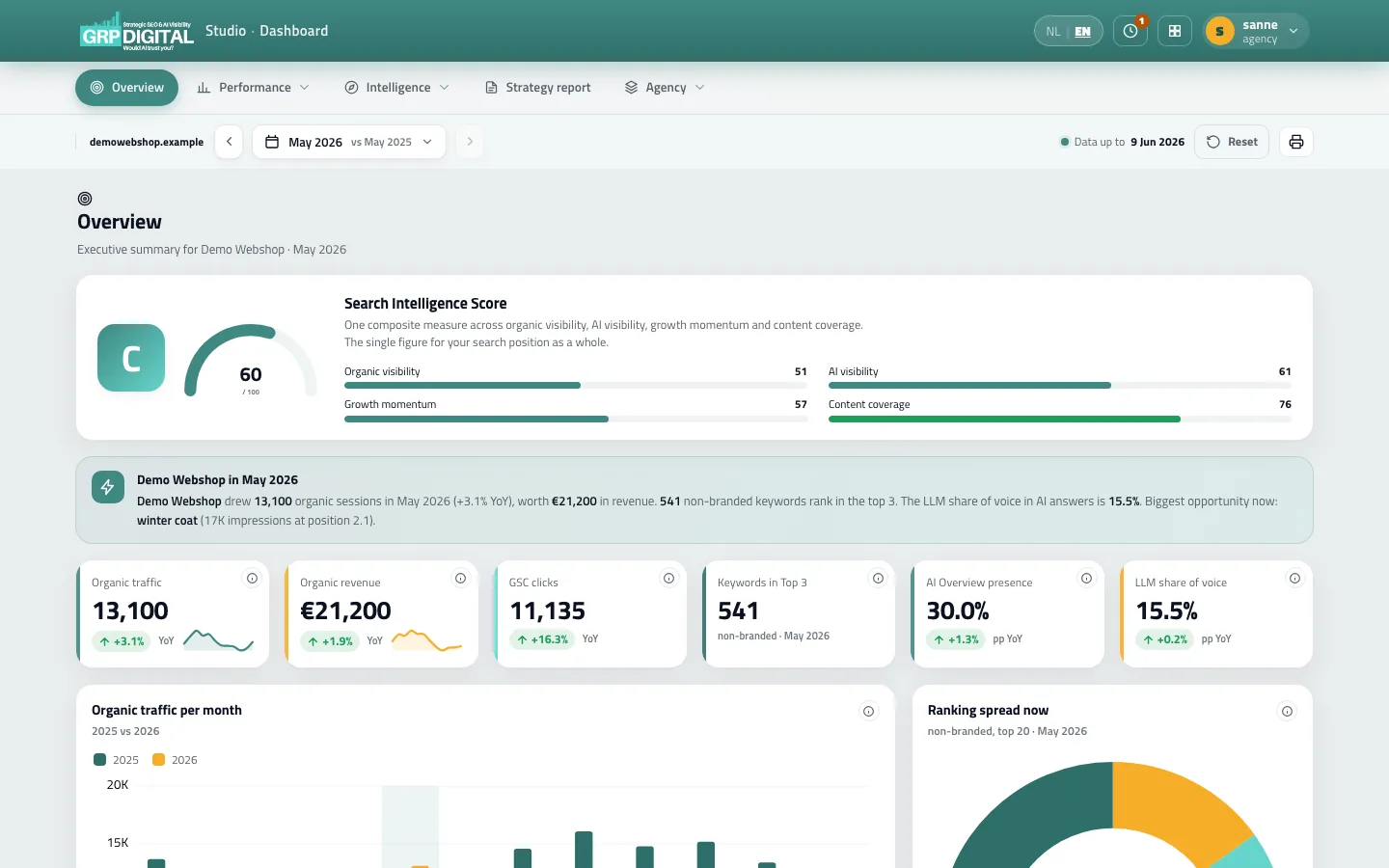
A tool can give you data, but a strategic specialist helps you weigh that data. That's exactly the difference between measuring and interpreting.
What you still have to do or organise yourself
You still have to make choices internally. Think of alignment with marketing, input on content from product specialists, technical follow-up and decisions about what happens first.
A strategic specialist sets out the route, but doesn't automatically walk every step for you. Without an internal owner, even a clear plan stays on the shelf.
When a strategic specialist doesn't fit
This choice fits less well if you mainly want direct production or are only looking for software. If you already have a clear course and mostly need ongoing execution, an agency is the more obvious choice.
Look closely, too, if you expect one party to take over everything completely. You can't fully outsource content, positioning and internal knowledge.
Choose an executing agency instead if you're still at the start of online marketing, first need to lay a broader foundation or aren't yet clear on which direction fits your business goals. And if one product carries the whole company and your brand is still small, holding off on SEO until the foundation is more solid can make more sense. That's why step one at GRP Digital is a full growth plan in which all relevant parts are analysed.
In a first conversation, it's also a clear signal for us when an organisation doesn't want a strategy and only wants to produce content and put it live. That's not how we work. It may well be that other things you haven't spotted yet make more impact with less effort.
When does a GEO agency fit you better?
A GEO agency fits better if you already know what matters and want to outsource the execution. This route makes sense if you have little time internally for optimising technical SEO, content and reporting, but do want to keep making progress.
An agency is often suitable once the direction is clear. Execution then has more value, because there's a plan underneath it and the work is heading somewhere.
What you get from an executing agency
You usually get support with technical SEO, content, reporting and optimisations that run over a longer period. Structured data, for example, is code that gives a page extra context, so search engines and an LLM better understand what the content is about.
Execution works best when the course is already clear. Otherwise you get activity without a clear order of priority.
It's still SEO. Only the priorities have shifted.
Giacomo Perticara, founder and SEO strategist at GRP Digital
What you still have to do or organise yourself
You keep providing input, making choices and keeping experts from your organisation available. An agency can take on a lot, but it doesn't automatically know your market, margins and nuance.
So keep asking what's being done, why that has priority now and how it connects to your wider goal. That stops reporting from drifting away from your business.
When a GEO agency doesn't fit
An agency fits less well if you first still have to find out where exactly the problem is. Without clear goals or internal support, execution becomes unfocused.
If you're mainly looking for an independent starting point, or first want to determine whether the bottleneck is in content, technical SEO or something broader, a strategic specialist usually makes more sense.
When does a content mill fit you better?
A content mill fits better if you're mainly looking for scale, speed and fixed formats. This choice makes sense if you need a lot of production and the topics, guidelines and quality standards are largely set.
Volume can be useful, certainly if you need many categories, supporting pages or a fixed publishing rhythm. But volume is only really valuable once you know which questions from the market matter.
What you get from a content mill
You usually get speed, formats, production capacity and a predictable rhythm. That helps if your organisation struggles to keep publishing going.
The limit is in prioritisation. If it isn't clear beforehand which themes, propositions and decision questions matter, output grows faster than impact.
What you still have to do or organise yourself
You have to supply sharp briefs, check the content and guard the coherence. With complex propositions especially, final editing is a core part of quality.
Authority plays a part here too. Authority means your knowledge comes across as credible and is confirmed by others.
When a content mill doesn't fit
A content mill fits less well if nuance, positioning and help with choosing are central. With complicated products or B2B questions you often need more than a tight format and a publishing schedule.
If you mainly want to know which question has to be answered first, which topic carries commercial weight and how you make proof and expertise visible, you first need strategic interpretation.
When does a tool fit you better?
A tool fits better if you mainly want to track visibility or need a first layer of measurement. This route makes sense if your team can analyse, prioritise and execute itself, and mainly needs the software for signals and for watching trends.
A tool is strong at measuring. A tool usually doesn't choose for you what matters more: technical SEO, content, internal coherence or positioning. That still takes human judgement.
For anyone who mainly wants to track how visible a brand is in AI answers, Measuring AI visibility is a useful next read.
What you get from a tool
You get dashboards, signals, prompt overviews or trends, depending on the tool. That helps you see patterns you'd pick up less quickly in regular analytics.
On its offer page, GRP Digital also names AI Share of Voice as part of the measurement side. Its practical value is in repetition: measuring the same set of questions again, so you can follow development over time instead of reacting to one isolated result.
One measurement is an anecdote. The trend across a fixed set, that is a KPI.
Giacomo Perticara, founder and SEO strategist at GRP Digital
What you still have to do or organise yourself
Interpretation, prioritisation and implementation stay with your team. That takes time, knowledge and someone who can make decisions.
Without that capacity you see a lot of numbers and not much changes.
When a tool doesn't fit
A tool fits less well if you need guidance, a clear point of view or help with change. Software gives signals, but it doesn't resolve internal doubt or unclear priorities.
If you're looking for one party that works with you, weighs choices and helps determine what's feasible, tooling alone is usually too narrow.
How do you assess a GEO specialist before you choose?
You recognise a good GEO specialist by clarity about measurement, scope, collaboration and limitations. You want to know how someone thinks and what someone offers.
Our view is simple: choose a party for its logic. Always dig deeper into three layers: measuring, interpreting and executing. If a provider mixes those three up, it gets hard to manage expectations well.
Questions you can ask in any introductory meeting
Use questions that show how someone reasons:
- How do you determine what has to happen first?
- Which signals do you measure repeatedly in the same way?
- What stays with our team?
- When do you recommend a different approach?
- How do you translate a baseline measurement into priorities?
- What do you expect from our subject experts?
These questions help, because you then see sooner whether someone mostly produces, mostly measures or really gives direction.
Signs that what's offered and the approach don't match
Watch for these signs:
- You want execution, but mostly get analysis.
- You're looking for direction, but mostly get output.
- Your team wants software, but nobody is going to follow up on the insights.
- You have complex propositions, but the approach mostly runs on fixed formats.
- There's little clarity about who decides or delivers internally.
You often see a mismatch like that as early as the first conversation. If the division of roles stays vague, the collaboration rarely gets easier once the work starts.
Which choice makes sense for your situation?
The logical choice depends on where you stand now. If you first want to know what has priority, choose a strategic specialist. If you mainly want the work carried out, choose an agency. If you want scale in production, choose a content mill. If you mainly want to track and compare, choose a tool.
If you're still in doubt, keep to one simple order: understand first, then organise, then scale up. That prevents your budget from draining away into work that has no clear function.
If you first want to go deeper into the differences between SEO, GEO and AI visibility, have a look at the AI visibility knowledge base.
Ready to get your starting position clear?
A good first step is to record your starting point and only then choose who has to do what. That helps, because you can then determine with more certainty whether you mainly need strategy, execution, production or tooling.
If you want to see which form fits that, have a look at the offer.
Frequently asked questions
What exactly does a GEO specialist do?
A GEO specialist helps you steer your visibility in search engines and AI environments with analysis, structure, content choices and measurement. What that looks like varies from one provider to the next. One party focuses on a baseline measurement and priorities, another mostly on execution or reporting.
Is GEO something different from SEO?
GEO is a layer within SEO. The emphasis shifts: understandable structure, answer-focused content, authority and presence in AI answers carry more weight. The foundation stays the same, because search engines and an LLM still have to be able to understand what your site is about.
When is a tool enough?
A tool is often enough if your team can run analyses, choose priorities and implement improvements itself. If you mainly have data but no clear course yet, a tool stays too limited. Measuring without interpretation rarely gives direction.
When does an agency fit better than a specialist?
An agency usually fits better if you already know what matters and are mainly looking for capacity for execution. A specialist fits better if you first want to determine where the real bottleneck is and what a logical first step would be.
When is a content mill a logical choice?
A content mill makes sense when scale and rhythm matter and your topics are already well defined. With complex products, decision questions or strong nuance, extra steering on content is needed, because production on its own doesn't produce good priorities.
How do you judge whether a GEO provider can really measure?
Ask which signals are tracked, whether the same set of questions is repeated each time and how the outcomes lead to choices. A reliable party makes clear what's a snapshot and what becomes a trend when you measure more often in the same way.
Do you also have to adjust your existing SEO approach for GEO?
Usually, yes. Your existing foundation also has to work for AI answers and other forms of online search behaviour. That often calls for sharper structure, better internal coherence and content that answers buyers' concrete questions faster and more clearly.
Can you outsource GEO completely?
No. You can have a lot guided or carried out, but your content, positioning and expertise stay important. The best outcome usually comes when a specialist or agency steers the process and your organisation supplies the subject knowledge and the decisions.


